Like Croatia, the Norwegian entry is going to have a problem with staging.
JOWST "Grab The Moment"
JOWST isn't the singer, Aleksander Walmann is the singer. JOWST is the producer--the man in the Daft Punk knockoff mask. He's come up with song that could be played in the background of an upscale clothing store like Uniqlo. "Grab The Moment" a song that sounds familiar, sounds like it was cutting edge a couple years ago, and obscure enough to have the cachet of cool.
I'm just interested to see how this song is going to be performed in Kyiv. There's a lot of mechanically recorded voices. That's one of the few verboten things at Eurovision. Vocals must be performed live. The chorus is Waldmann's voice put through electronic processing and if this is allowed, there could be a precedent setter.
I don't see the song being an obvious qualifier. Although there's some producing wizadry at work in the song, the staging is deathly static. There's nothing to catch the eye and during the national final performance, I was critiquing Waldmann's hat and shirt combo, which is not a good sign.
Every year at Eurovision there is one song where I vigorously disagree with the rest of the Eurovision fan base, and this year Norway has sent that song.
Yep, a lead balloon. A metaphor for the Norwegian entry.
Mørland & Debrah Scarlett "A Monster Like Me"
For me, this is the worst song of the forty entries. The twee vocals, the swoony strings, and the melodramatic staging are so repellent to me in visceral way. I have only been able to watch the clip once all the way through. Any other attempts cause me to cringe and switch to something else.
However, it ticks all the boxes for a top ten finish on the night of the finals, so "A Monster Like Me" is getting a lot of love from Eurovision fans.
---
I personally wish that the Norwegians had chosen a different song, one that was upbeat and completely silly.
Staysman & Lazz "En godt stekt pizza"
Country techno with rap. It's kind of off the wall and insane but this song is the only song I've seen throughout the final that was silly and fun. Eurovision needs to be silly and fun and I would have loved for this to go to Vienna.
But, serious we must be and we have another dramatic duet. At least I know when I'm going to make myself a cup of coffee during the first semi final.
As you know, since you're reading my blog, Azerbaijan won last year's contest and they have the hard task of following up their winning song.
In recent years, countries have had a hard time repeating the success of their previous year's winner. A good case in point is Norway in 2010.
Oslo had the honor of hosting the contest after winning the previous year with this song:
Alexander Rybak "Fairytale" Norway 2009
"Fairytale" was the runaway winner of that year's contest, getting 169 more points that the second place finisher.
The next year, they sent this song:
Didrik Solli-Tangen "My Heart Is Yours" Norway 2010
It's a completely different song, and it came in twentieth in the final that year.
With that in mind, take a listen to this year's Azerbaijani entry:
Sabina Babayeva "When The Music Dies"
I have a suspicion that his is going to fall to the same fate that Solli-Tangen did a few years ago, and get nowhere near the top ohalf of the board at the end of the contest.
But unlike Solli-Tangen, whose issues was really a voice that was burned out, Ms. Babayeva has an even bigger issue--an inability to actually interpret the song.
"When the Music Dies" is a ballad, and you must be able to not only sing the song tunefully, but be able to interpret them in a way that shows you understand the feeling behind the song, and Ms. Babayeva can only do the first. Since English isn't her first language, Ms. Babayeva comes off sounding like an automaton, not a real live human being.
It's very difficult to be able to find the emotion when singing in another language--I would have the same difficulty singing in German--a language I have a tenuous grasp on. Unfortunately, she's trying to appeal to a pan-European audience and I don't think this was the song for her to do that.
Strangely, the 1960 contest didn't take place in the Netherlands. It's an unwritten rule the the previous year's winner has the privilege of hosting the following year's contest. But because the Dutch national broadcaster had hosted two years previously, they declined the honor. Since the United Kingdom came in second, The BBC picked up the slack and the contest went to London and the Royal Festival Hall.
Thirteen countries, entered the contest, with Luxembourg returning from a one year absence and Norway debuted with an interesting number about a Sami girl pining for her boyfriend.
Nora Brockstedt "Voi Voi" Norway
Sadly, Ms. Brockstedt didn't win the contest, she came in equal fourth place along with the German entry--with 11 points.
The winner was the final song performed in the contest, the French entry, sung by the comely Jacqueline Boyer.
Jacqueline Boyer "Tom Pillibi"
It's a pretty song, but I don't envy her. Tom Pillibi is a con artist and he's got the girl under his spell--he tells her that he's got castles in different places in Europe, but she knows it's a complete lie, but forgets it all when he holds her. Co-dependant anybody? Or is she a gold digger?
So naturally, I sent the songs out to my Eurovision jury so we could determine who we think the winner should be, and neither Ms. Brockstedt or Ms. Boyer did well. We put "Tom Pillibi" in third place, while "Voi Voi" came in eleventh.
Our choice for the best song of the year was the Monegasque entry. Although on the night, the European juries placed it fairly high--it came in third, following the United Kingdom, it was the only song that rated highly with all of the Alaska judges.
François Deguelt "Ce soir-là" Monaco
You could read this one as a companion piece to "Tom Pillibi". In "Ce soir-là", Deguelt is pining for the first night he held his lover in his "arms", and is disconsolate that she left him. My guess is that Tom Pillibi promised her castles. and that was that...
And for those enough nerdy enough to want to know our results, just drop me a line, and I'll be glad to share our rankings.
And that's 1960 in a nutshell. Stay tuned for 1961.
Countries keep selecting their entrants for the Eurovision Song Contest, and I've become lax in posting up in the blog.
But anyway, Norway chose their entrant last weekend, and the Iranian-Norwegian singer Tooji won with his song "Stay".
It's a solid, if rather heavy club song, well performed and choreographed. But it does sound like a knockoff of last year's Swedish entry
Tooji himself has stage presence and is very easy on the eyes, which will help him as well. In other words, it's likely to do well.
Personally, I'm not wild about the song. I doubt I'd listen to it more than once or twice before skipping over it. I dislike the musical pandering to Eastern Europe in the opening and the hard pumping club beat that is the basis of the song is totally not my thing.
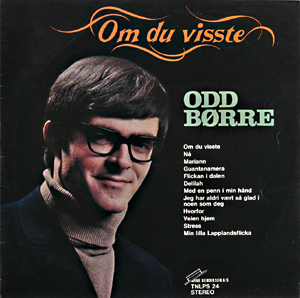
While most people know about the most famous people, like the subject of my last post, ABBA. The artists I consider "Eurovisionary" are not that well known, like this gentleman.
Yep, you're reading the name correctly, you wacky English speakers.
Mr. Børre represented Norway in the 1968 Eurovision Song Contest with the song "Stress".
Odd Børre "Stress"
Who on Earth would think that this guy, who looks and dresses like an accountant going to a smart party, would have represented a country with a weirdly cacophonous song about missing a bus?
Odd was a perennial also ran to represent Eurovision at the ESC, only making it in 1968. A few years after this perromance, he decided to retire from music to become an insurance salesman. Yes, I'm serious. An insurance salesman.
For me, Børre's song is gets to the heart of why I love the Song Contest so much. The obscure artists and the odd songs have made me a follower of the contest, and keep bringing me back year after year.