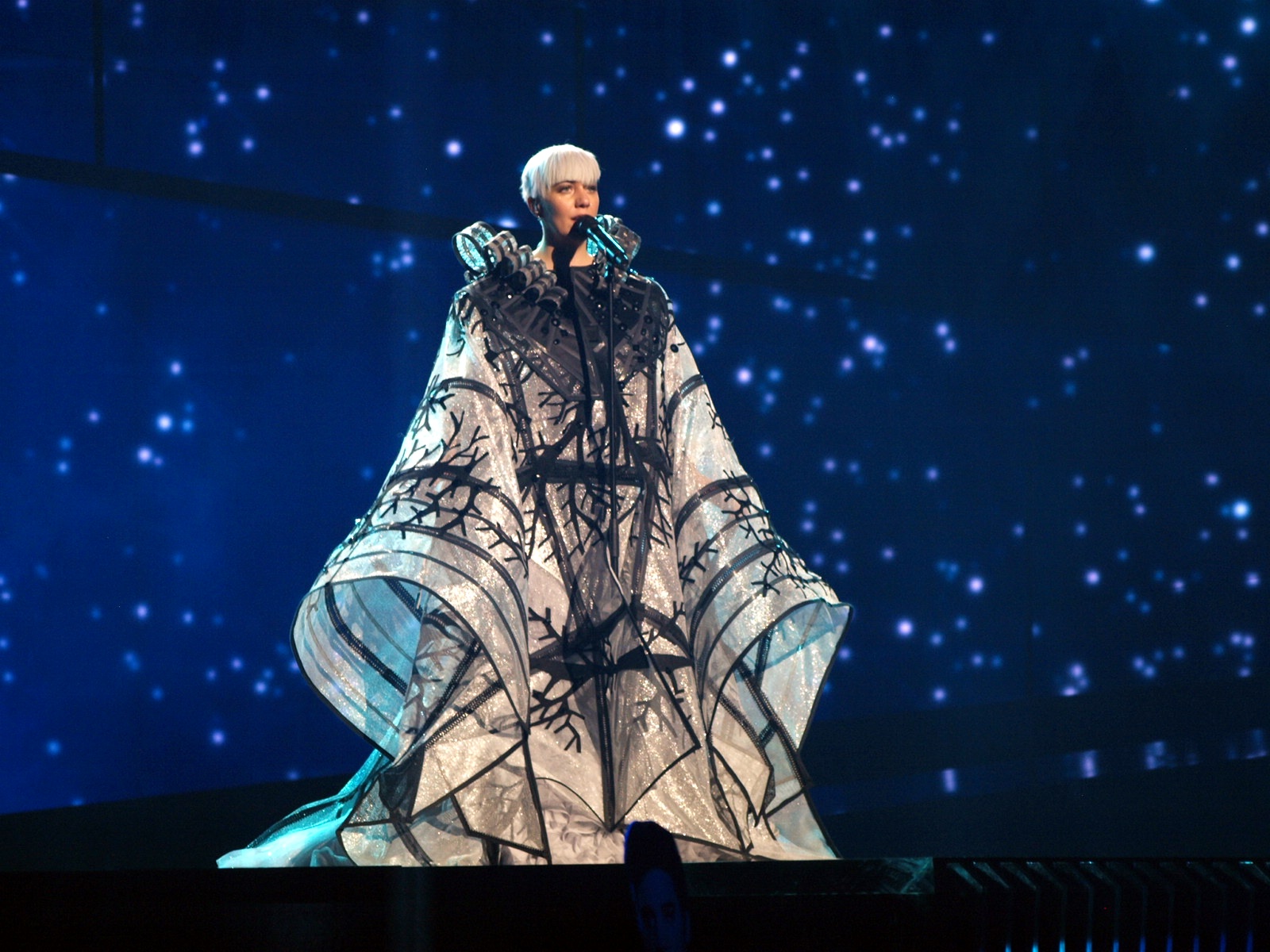
I love the Montenegrin Eurovision entries. Montenegro is a country that has always been experimental when it comes to Eurovision and this year is no exception.
Slavko Kalezić "Space"
We have a track that might have been played at the local gay bar back in 2009!
Kalezić's attempts to be sexy while singing this single entendre in music form is absolutely hilarious and I look forward to the "spectacle" that will be his live performance. We haven't had a song that has pandered to the gay audience in this way in ages.
I don't think it will make it out of the semifinal, but it will be a fun three minutes.
When the Belgian broadcaster released "City Lights", the fan community went crazy. I can understand the excitement. The song sounds modern and the video exudes cool.
Blanche "City Lights"
However, I thought there was something off with the song, which I didn't understand until I heard it live.
Blanche "City Lights (Live from London Eurovision Party 2017)*
Blanche was shoehorned into a song that is not suited for her and the live performance shows that. The backing track overwhelms her and her performing style deadens the energy of the song.
RTBF, the Franco-Belgian broadcaster wanted a follow up to the big success of their entry two years ago--Loïc Nottet.
Loïc Nottet "Rhythm Inside" 2015
It's understandable that the broadcaster went back to the same blueprint for this year's contest and chose "City Lights" as the song they wanted to send.
Now, take a listen to Blanche's audition song to The Voice Belgique, the singing program where Blanche got her start as a professional singer.
Ellie Delvaux (a.k.a. Blanche) "Daydreamer"
I'm sure the broadcaster was hoping for a singer that would give a cool vibe to the song--like Astrud Gilberto or Nico. It doesn't work. Blanche comes across as scared, not coolly confident.
I'm certain the broadcaster has plans for Blanche that will address this with the staging in Kyiv, but I can see Belgium being the shock non-qualifier from Semifinal One.
Albania seems to be in a rut. For the past four years, they have sent a woman with a huge voice singing a string heavy power ballad.
Albania has not had a good track record qualifying in recent years with women with huge voices singing power ballads and in a year where there are a lot of women with huge voices singing power ballads, this year's Albanian entrant has to find something to make herself memorable.
Lindita "Bote"
Lindita "World"
As you can see in both the original Albanian entry and the English revamp, Lindita has chosen to feature her ass.
Her ass is lovely, but when I'm more interested in her ass than her song, there's a problem.
He sex appeal is the way she'll make it into the Eurovision final, but I want Albania to stop sending this type of song to Eurovision. Send another ethnic-influenced hair band! Send a disco diva! Stop the melodramatic ballads!
This is Australia's third year in the Eurovision Song Contest and I think they're here to stay.
Like Australia's other two entrants, Firebrace was selected internally by the Australian broadcaster SBS to represent them in Kyiv. Like the other two entries, Firebrace has also one a major televised singing completion, in his case the 2016 edition of X Factor Australia.
Isaiah Firebrace "Don't Come Easy"
There's no denying that Firebrace has a good voice (although he has a nasty case of unnecessary melisma for no reason that comes from performing in singing competitions). The song is structured to showcase his soulful voice. In other words, the framework has been built to create a very competitive Eurovision performance.
I am looking forward to seeing how this is staged and the song should qualify for the final.
There's something really hard about being the first country to declare your song in Eurovision--it will be compared to every other Eurovision song.
Tamara Gachechiladze "Keep The Faith"
Comparisons are very easy for this song. You take the Bond theme theatrics of Conchita Wurst's winning song from 2014 and combine it with the political message of Jamala's winning entry of last year and you get "Keep The Faith".
The song has courted controversy due to the staging of the national final performance--especially at 1:27, when a graphic of a newspaper stating "Russia Invades Geo..." is prominently features on the screen behind her.
It's not the first time Gachechiladze has been a part of this sort of musical brinksmanship before. She was a part of the Georgian entry in 2009 that was disqualified because it had lyrics that were considered to be political speech.
3G and Stephane "I Don't Wanna Put In"
I suspect that the political staging of the national final will be swapped out for something more Eurovision friendly, but I think this is a song on the bubble for qualification. There are a lot of power ballads sung by attractive women and this is very early in the semifinal and is likely to be forgotten.
First up is the Eurovision powerhouse nation of Sweden
Sweden is the master of modern Eurovision, and this year's entry is another example of why the country has that reputation. "I Can't Go On" is a piece of pop that sounds like it should be on a Top 40 station with a performance has been polished to a sheen. Take a look at the video below to see what I mean.
Robin Bengtsson "I Can't Go On
Everything about the song is meant to have immediate impact, which is going to pull in casual voters when they see it in the final. There's no doubt that Sweden will make the final.
However, I think this song is one of the worst entries this year. If you take away the bells and whistles of the staging, the song is really terrible--it comes across as a knockoff of a Maroon 5 or Justin Timberlake song.
In other words I've heard this song before.
This could be forgiven if Bengtsson had personal charisma. However, watching this performance, Bengtsson comes off as stiff and mechanical. To make this work, Bengtsson needs to charm my pants off. Instead, he's coming across as all swagger and no sex appeal. It's more funny than sexy.
I'm sure this is a top five song. I just don't have to like it.
It's been a month since the final of the Eurovision Song Contest, and only now have I felt the need to sit down and write about it, because unlike many previous years.
1. Logo kind of ruined Eurovision for me.
I have to say that at first blush, Logo and the Eurovision Song Contest seemed to go together quite well. The Eurovision Song Contest has a huge gay following and Logo is the "gay" network.
But when my husband and I tuned in, I was kind of appalled by the slapdash commentary provided by Carson Kressley and Michelle Collins. Neither of them knew much about Eurovision and Kressley's ignorance combined with vapidly pointless comments made me very angry. It's something that I hope that they don't repeat in the future.
2. There is no way for people in the US to watch Eurovision.
Because of the agreements between the EBU and Logo, the site at Eurovision.TV that allows you to stream the contest at will is not longer available here in the United States. All the clips of the contestants are blocked, and this means I can't link to any of them here in this blog.
Croatia's entry was supercool, but I can't post it in my blog because I'm in the US. (source eurovisionary.com)
I suspect that Viacom, the company that owns Logo and all the other NBC networks is attempting to cash in on Eurovision. I don't see this happening any time soon and hope they will allow us to view them soon.
I doubt that--it just means that I'll likely get a DVD of this year's contest and watch it on my European DVD player.
3. The winning song was the best song in this year's contest.
There was a lot of sour grapes when the voting ended and Ukraine wound up winning the contest, especially among Russians, who felt that the rightful winner was the Russian entry.
But my little Eurovision party disagreed with that, as my friend Lori said, Jamala's performance "gave (her) goosebumps".
Even in this clip, the winner's reprise, there is still power in the song
Jamala "1944"
Needless to say, it was the winning song in my little Eurovision viewing party as well. It's the first time my friends and the European public have agreed on the winning song.
4. The new voting system worked.
I wasn't a fan of the new voting system, where the countries' jury votes were announced separately and the public votes were combined together when it was announced. But when it was put into practice, the suspense was nail biting.
When the points for the winner of the televote were announced, Russia Sergey Lazarev, I fell on the floor when the points he received were not enough to win.
The voting can stay.
And that's pretty much it for me. I wish I could say more, but the inability to share the clips here takes away most of the fun.